

Good garden lighting does more than simply illuminate your outdoor space. The right lighting creates atmosphere, highlights beautiful trees and plants, and makes your garden an extension of your home after dark.
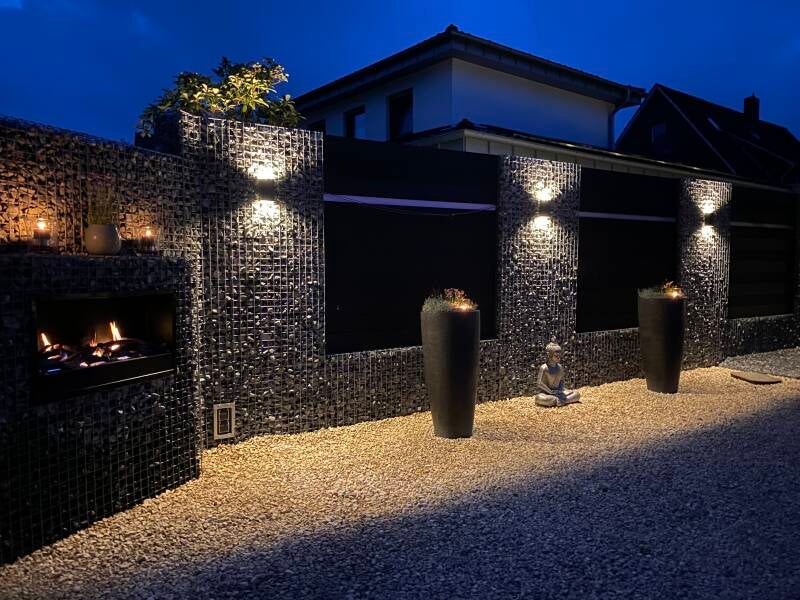
But when you start planning your garden lighting, you quickly come across an important question. Should you choose 24V garden lighting or 230V?
Both systems have their own applications. The right choice depends on the type of garden, the number of lights you want to install, how you want to design the lighting system, and whether you want the option to expand it in the future.
What Is the Difference Between 24V and 230V Garden Lighting?
The main difference is the voltage used by the lighting system.
With 230V lighting, the lights are connected directly to the mains supply. With a 24V system, a transformer is used to convert the mains voltage from 230V down to 24V.
A 24V system typically consists of a transformer, a main cable and several lighting points. The individual lights are then connected to the cable using suitable connectors.
This makes 24V garden lighting particularly suitable for complete outdoor lighting systems where multiple lights are distributed throughout the garden.
24V Garden Lighting
24V garden lighting is increasingly popular for modern outdoor lighting systems. The system is flexible to install and allows multiple lights to be connected together.
Safety
One of the important advantages of a 24V system is the lower voltage. The lighting is powered by a transformer that converts the mains voltage to 24V.
This makes a 24V system particularly interesting for applications where cables run through the garden and lighting points are installed in different locations.
Of course, every electrical installation should be installed in accordance with the applicable local regulations and safety requirements. If you are unsure about the electrical connection, we recommend consulting a qualified electrician.
Easy Installation
A 24V system can be designed in a simple and organised way.
You install the transformer in a suitable location and then run the 24V cable to the different lighting points.
With the right connectors, you can connect lights at different points along the cable without having to run a separate power cable back to the electrical panel for every individual light.
This is particularly useful when you want to install lighting around a terrace, flower bed, tree, swimming pool or garden path.
Easy to Expand
One of the biggest advantages of 24V garden lighting is its flexibility.
Want to illuminate an additional tree later? Add a few spots to a flower bed? Or install extra lighting around your terrace?
A 24V system can often be expanded easily, provided that the transformer, cabling and total electrical load are suitable for the additional lighting.
Explore our 24V garden lighting to discover the different lights that can be combined within your outdoor lighting system.
24V Cables and Connectors
The right cables and connectors are an important part of a 24V garden lighting system.
The cable effectively forms the backbone of your outdoor lighting installation. The individual lights are connected to this main cable.
With a T connector for 24V garden lighting, for example, you can create an additional branch for another light or section of your garden.
This allows you to create a much cleaner and more flexible lighting plan than running a separate cable to every individual light.
Choosing a Transformer for Your Garden Lighting
Because 24V lighting cannot be connected directly to 230V mains power, you need a suitable transformer.
When choosing a transformer, it is important to consider the total wattage of all connected lights.
If you have several LED spots, bollard lights and other lighting points, add the wattage of the individual lights together and choose a transformer that is suitable for the total load.
Explore our 24V transformers when building your own outdoor lighting system.
24V Garden Lighting for Large Gardens
24V can also be an excellent solution for larger gardens.
You can divide the garden into different lighting zones. For example:
Flower beds around the terrace.
Trees and larger plants.
The exterior walls of your home.
Garden paths.
Areas around a swimming pool.
Outdoor seating and lounge areas.
By creating a lighting plan before installation, you can avoid placing lights everywhere without a clear purpose.
Good garden lighting is not about using as much light as possible. It is about highlighting the elements you want to see and enjoy after dark.
Smart Control for 24V Garden Lighting
A 24V system can also become part of a smart garden lighting installation.
For example, you can use a Smartbox or smart control system to switch your lighting automatically.
Imagine your garden lights turning on automatically every evening, different lighting zones being controlled separately, or your outdoor lighting being controlled from your smartphone.
This can be particularly useful when you have several areas of your garden that you want to control independently.
Explore our Smartboxes and smart garden lighting if you want to make your outdoor lighting smarter.
When Is 230V Garden Lighting a Good Choice?
230V garden lighting also has its applications.
In some installations, it can be practical to work directly with 230V. For example, when a suitable electrical connection is already available and the lighting is being installed as a fixed system.
230V lighting can also be suitable for certain powerful fixtures or specific applications that are designed to operate directly from the mains supply.
Because 230V involves mains voltage, the installation must be carried out in accordance with the applicable electrical safety regulations. Depending on the installation, a qualified electrician may be required.
24V or 230V: What Should You Consider?
There is no single system that is the right choice for every garden.
Consider the following points when planning your outdoor lighting:
How large is your garden?
For a large garden with multiple lighting points, a well-designed 24V system can provide a high level of flexibility.
How many lights do you want to install?
The more lighting points you have, the more important it becomes to calculate the total electrical load and plan the cable layout correctly.
Do you want to expand the system later?
If you think you may add more lighting in the future, it is worth considering this during the initial installation.
Do you want smart control?
If you want to control different lighting zones automatically or independently, a smart 24V system can be an interesting solution.
How will the lighting be installed?
The cable route, cable length, electrical load and location of the transformer all play an important role in designing the system correctly.
Our Approach to Complete Garden Lighting
For a complete garden with multiple lighting points, 24V is often a practical way to create a flexible outdoor lighting system.
You can start with a few key lighting points and expand the system later as your garden develops.
For example, you could combine spots for trees, atmospheric lighting around the terrace and lighting along a garden path.
The result is a garden where different lighting points work together to create a balanced atmosphere, without every light needing its own separate connection.
When planning your garden lighting, don’t start by asking how many lights you need. Start by asking what you want to highlight and enjoy after dark.
From there, you can choose the right lighting, cables, connectors and transformer for your garden.
At SmartGardenXL, we are here to help you create an outdoor lighting system that makes your garden look just as beautiful at night as it does during the day.