

One of the first questions people ask when planning outdoor lighting is simple:
How many garden lights do I actually need?
The answer is not simply one light for every 5, 10 or 20 square metres.
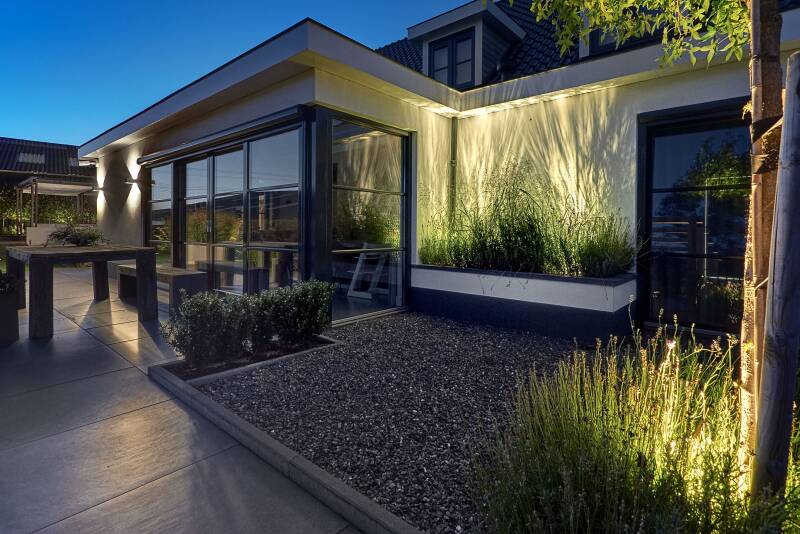
A well designed garden lighting plan is about much more than the size of your garden. The number of lights you need depends on what you want to illuminate, the size of the plants and trees, the layout of your garden, and the atmosphere you want to create.
A 50 m² garden with a large terrace, several trees and a pathway may need completely different lighting from a 50 m² garden that consists mainly of lawn.
At SmartGardenXL, we believe outdoor lighting should not make your garden brighter just for the sake of being brighter. The goal is to create depth, atmosphere and focus, while keeping the garden natural and comfortable at night.
Start with your garden, not the number of lights
Before buying any garden lights, divide your outdoor space into different areas.
Think about:
Borders and plants
Trees and larger plants
House and exterior walls
Pathways and entrances
Terraces and seating areas
Swimming pools
Driveways and parking areas
Each area has a different lighting purpose.
For example, a pathway usually benefits from subtle, evenly distributed lighting, while a large tree can become a beautiful focal point with one carefully positioned spotlight.
This is why there is no universal formula for the perfect number of garden lights.
How many lights for a 25 m² garden?
A small garden does not necessarily need lots of lights.
For a garden of around 25 m², you might start with approximately 4 to 8 lights, depending on the layout.
For example:
2 to 3 lights for plants, borders or small trees.
2 to 3 lights around a terrace or pathway.
1 to 2 additional lights for an entrance, wall or architectural feature.
The important thing is to avoid placing a light everywhere.
Instead, choose a few important features and create contrast between light and shadow.
For pathways or borders, a product such as the Sus Sense Black 24V can provide soft, warm ambient lighting. It has a 360° beam and a light range of approximately 2 metres, making it suitable for paths, borders and terraces.
How many lights for a 50 m² garden?
For a 50 m² garden, approximately 6 to 12 lights can be a useful starting point.
But again, this is not a strict rule.
A possible layout could be:
3 to 4 lights for borders and plants.
2 to 4 spotlights for trees or larger features.
2 to 3 lights around a pathway or terrace.
1 to 2 lights for the house, entrance or another architectural feature.
For trees and larger plants, a spotlight is often more effective than several smaller lights.
The Sus Small Calla 2.2 24V, for example, can illuminate up to 8 metres and has a 60° beam angle. This makes it suitable for highlighting trees, borders and other garden features.
How many lights for a 100 m² garden?
Once you reach around 100 m², planning becomes even more important.
You could be looking at approximately 10 to 20 lights, depending on the garden design.
Instead of spreading 20 lights evenly across the garden, divide the garden into zones.
Zone 1. Terrace
Use subtle lighting around seating areas and the edge of the terrace.
Zone 2. Borders
Use selected lights to highlight plants and create depth.
Zone 3. Trees
Use spotlights to bring larger trees and architectural plants to life after dark.
Zone 4. Pathways
Use low-level lighting to guide people through the garden.
Zone 5. House
Use wall lighting to highlight architectural details.
For walls and architectural features, SmartGardenXL offers several 24V outdoor wall lights, including the Sus Sphere, Sus Mini Square and Sus Square.
How many lights for a 200 m² garden?
A 200 m² garden can require considerably more planning, but that does not mean you should simply install twice as many lights as in a 100 m² garden.
A larger garden is often better divided into separate lighting zones.
You might use:
4 to 8 lights around the terrace.
5 to 10 lights for borders and plants.
4 to 8 spotlights for trees and larger features.
4 to 8 lights along pathways and entrances.
Additional wall or architectural lighting around the house, pool or outdoor structures.
The final number could therefore be somewhere around 15 to 30 lights, but the right number depends entirely on the garden.
A large garden with several mature trees might actually need fewer lights than a smaller garden with lots of pathways and architectural features.
The most important question: what do you want to illuminate?
Instead of asking:
“How many lights do I need?”
Ask:
“What do I want to see after dark?”
That small change in thinking can completely change the result.
Plants and borders
You do not need to illuminate every plant.
Choose individual plants, groups of plants or interesting textures and highlight them selectively.
This creates depth without making the entire border look flat.
Trees
Trees are one of the easiest ways to create a dramatic effect.
Depending on the size of the tree, you may need one or several spotlights.
For taller trees or trees further away from the light source, a more powerful or focused spotlight can be useful.
The Sus Small Calla Focus 3.2 24V has a focused 25° beam and a reach of up to 12 metres, making it suitable for highlighting larger trees and architectural features.
House and walls
Wall lighting can make your house look completely different at night.
Rather than illuminating an entire wall with powerful floodlighting, consider highlighting entrances, architectural details or sections of the façade.
SmartGardenXL’s range of 24V outdoor wall lighting includes several designs that can be used for houses, walls and fences.
Pathways
Path lighting should help people move safely without becoming the main feature of the garden.
Avoid creating a runway effect by placing identical lights in a perfectly straight line.
A staggered layout can often create a much more natural result.
Terrace
Your terrace is where you will probably spend the most time after dark.
The lighting here should therefore be comfortable and atmospheric.
Think about indirect lighting, subtle floor lighting and warm accent lighting rather than simply using the brightest possible lamps.
Swimming pool
A swimming pool can become a strong focal point at night.
But you do not necessarily need to illuminate the entire pool area.
Consider the surrounding planting, walls, pathways and architectural elements as well.
This creates a more layered result than simply making the pool extremely bright.
Driveway
For a driveway, visibility and guidance become more important.
Low-level ground lights or subtle bollard lighting can help define the edges without creating glare for people arriving at the property.
SmartGardenXL offers dedicated 24V LED ground spots for paths and other outdoor applications.
Don’t put a light everywhere
One of the most common mistakes with garden lighting is thinking:
More lights = better lighting.
It doesn’t.
A beautiful lighting plan uses light and darkness together.
If every plant, wall, tree and pathway is illuminated at the same brightness, the garden can lose its depth.
Instead, create layers.
Background lighting
Soft illumination that gives the garden an overall atmosphere.
Accent lighting
Focused light that draws attention to a tree, plant, wall or architectural feature.
Functional lighting
Lighting that helps with pathways, entrances, stairs and other practical areas.
This combination creates a much more natural and premium result.
Plan your lighting before you install it
Before buying your lights, make a simple plan of your garden.
Mark:
Borders
Trees
Walls
Pathways
Terrace
Pool
Driveway
Then mark the areas you want to highlight.
Only after that should you decide how many lights you need.
For a 24V system, you can then plan your cable routes, connectors and transformer capacity around the lighting design. SmartGardenXL offers different 24V cables, T-connectors, transformers and Smartboxes for building a complete outdoor lighting system.
The right number of lights is the number that creates the right atmosphere
So, how many garden lights do you need?
As a general starting point:
25 m² garden: approximately 4 to 8 lights.
50 m² garden: approximately 6 to 12 lights.
100 m² garden: approximately 10 to 20 lights.
200 m² garden: approximately 15 to 30 lights.
But don’t treat these numbers as a rule.
The perfect lighting plan depends on the garden itself.
A smaller garden can need more lights if it contains lots of different features. A large garden can look beautiful with relatively few carefully positioned lights.
The goal isn’t to light everything. The goal is to highlight the right things.
With the right combination of outdoor spotlights, ground lights, wall lights and ambient lighting, you can create a garden that feels completely different after sunset.
And that is where good garden lighting makes the biggest difference.