

One of the most common questions when planning garden lighting is simple.
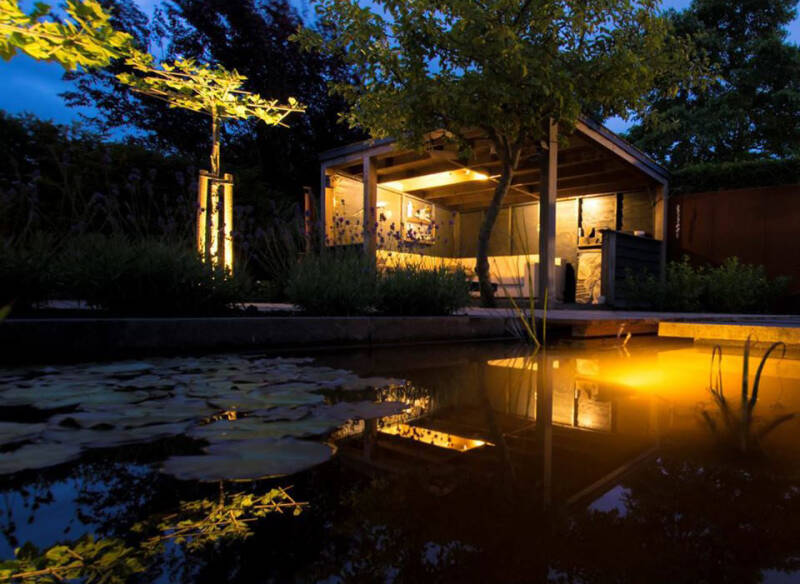
How far apart should garden lights be?
There is no single distance that works for every garden. The ideal spacing depends on the type of light, the size of the area, the brightness of the lamp, the beam angle and, most importantly, what you want to highlight.
Good outdoor lighting is not about placing as many lights as possible. It is about creating the right balance between light and shadow.
In this guide, we explain how far apart to place different types of garden lights and how to create a natural, professional looking result.
How far apart should path lights be?
Path lights are mainly used to guide people through the garden while creating a warm and welcoming atmosphere.
As a general guideline, placing path lights approximately 2.5 to 4 metres apart often creates a good balance.
For a narrow pathway, you can place the lights closer together. For a wider pathway or a larger garden, you can increase the distance.
You also do not always need to place every light directly opposite each other.
Instead, try alternating the lights from one side of the path to the other.
This creates a more natural lighting pattern and avoids creating a tunnel of light.
Practical guideline:
2 to 2.5 metres apart for stronger and more continuous lighting.
2.5 to 4 metres apart for a softer and more atmospheric effect.
4 metres or more when you want individual areas of light rather than continuous illumination.
For a premium outdoor lighting system, products such as SmartGardenXL path and garden lights can be combined to create different lighting zones throughout the garden.
How far apart should bollard lights be?
Bollard lights are ideal for driveways, pathways, terraces and larger garden areas.
A good starting point is approximately 3 to 5 metres between each light.
However, the height and brightness of the bollard make a big difference.
A low bollard with soft light may need to be positioned closer together, while a taller or brighter fixture can cover a larger area.
Rather than focusing only on distance, look at the area of light created by each fixture.
You want the light from one fixture to complement the next without creating large dark gaps.
How far apart should garden spotlights be?
Spotlights work differently from path lights.
You normally use a spotlight to highlight something specific rather than simply illuminate an area.
Think about:
Trees.
Palm trees.
Large plants.
Walls.
Architectural details.
Garden features.
This means there is no fixed distance between spotlights.
For example, if you are lighting individual trees, you might have 2 to 5 metres between the fixtures, depending on the size and position of the trees.
For larger trees, you may even use two or more spotlights positioned at different angles.
Use the beam angle to determine the spacing
The beam angle is particularly important.
A narrow beam creates a concentrated beam of light and is ideal for highlighting a tree trunk, palm tree or architectural feature.
A wider beam spreads the light over a larger area and is better suited to borders, shrubs and general garden lighting.
This is why two spotlights with the same wattage can produce completely different results.
If you are looking for flexible garden spotlights, take a look at our [SmartGardenXL outdoor spotlights] and choose the right beam and light output for the feature you want to highlight.
How far apart should ground lights be?
Ground lights are often used to illuminate pathways, driveways, terraces, walls and architectural details.
For general pathway lighting, a distance of approximately 2 to 4 metres can be a good starting point.
However, ground lights are also excellent for creating visual patterns.
You can place them closer together when you want a continuous line of light.
Or you can increase the distance when you want individual points of light.
When lighting a wall, for example, you may want to position several ground lights at regular intervals to create an even wash of light across the surface.
For trees or architectural features, the spacing should instead be based on the position of the object you want to illuminate.
Should garden lights be placed directly opposite each other?
Usually, no.
When lighting a pathway, placing lights directly opposite each other can create a very symmetrical appearance.
That can work in some modern gardens, but in many situations a staggered layout looks more natural.
For example:
Left → 3 m → Right → 3 m → Left → 3 m → Right
This creates a softer rhythm throughout the garden.
It also prevents the pathway from becoming excessively bright.
How many garden lights do you need?
The number of lights you need depends on the size and layout of the garden.
But instead of calculating the number of lights based only on square metres, divide the garden into different zones.
For example:
Entrance
Use subtle lighting to make the entrance welcoming and easy to find.
Pathways
Use path or bollard lighting to guide people through the garden.
Borders
Use spotlights to highlight plants, trees and textures.
Terrace
Use atmospheric lighting rather than very bright functional lighting.
Pool area
Use carefully positioned lighting to highlight the surroundings without creating glare.
Trees and architectural features
Use spotlights with the right beam angle to create depth.
This approach usually produces a much better result than simply installing lights at equal distances throughout the entire garden.
Do not make every light equally bright
One of the biggest mistakes in garden lighting is using the same brightness everywhere.
A beautiful garden often combines different levels of light.
Some areas can be brighter.
Some areas can remain darker.
This contrast creates depth and makes the garden look more interesting at night.
For example, you could use subtle path lighting combined with stronger spotlights on a large palm tree.
The pathway remains comfortable to walk along while the palm becomes the visual focal point.
A simple rule for planning your garden lighting
If you are not sure where to start, use this simple method.
Step 1. Walk through the garden during the day.
Identify the areas you want people to notice.
Step 2. Divide the garden into zones.
Think about paths, terraces, plants, trees, walls and entrances.
Step 3. Choose the type of light for each zone.
Not every area needs the same type of fixture.
Step 4. Start with fewer lights.
It is usually easier to add another light than to remove several lights later.
Step 5. Test the lighting at night.
The final spacing often becomes obvious once the lights are switched on.
Create atmosphere, not just illumination
The best garden lighting does more than make a garden visible after dark.
It creates atmosphere.
It highlights the architecture of your home.
It brings trees and plants to life.
It creates depth.
And it makes outdoor spaces feel just as inviting at night as they do during the day.
That is why the question should not only be:
“How far apart should my garden lights be?”
A better question is:
“What do I want my garden to look like at night?”
Once you know that, choosing the right lights and spacing them correctly becomes much easier.
Ready to plan your garden lighting?
Whether you are lighting a small terrace, a Mediterranean garden or a large villa garden, the right combination of fixtures can completely change the atmosphere after sunset.
Explore the SmartGardenXL outdoor lighting collection and find the right lighting for your garden.
You can combine path lights, spotlights, bollards and other outdoor lighting to create a complete and balanced lighting plan.
SmartGardenXL. Premium Outdoor Lighting.